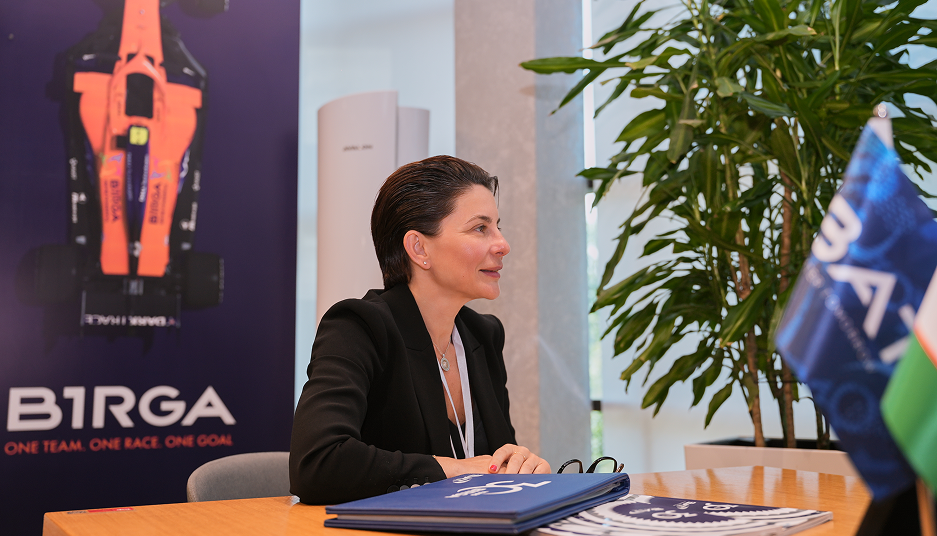
Over more than 20 years of international work, Mona has worked in Switzerland, the UAE, and Jordan, and today leads one of BAT's largest and most dynamically developing regions.
In this interview, she discussed her professional journey, shared her perspective on leadership and the role of women in business, explained how BAT is transforming, and expressed her opinion on Uzbekistan's potential as an investment and export hub for the region.
You lead corporate and regulatory affairs in 16 countries—from Central Asia and the Caucasus to the Middle East and North Africa. Looking back, what was the turning point in your career?
Looking back, the most significant turning point in my career was the realization that leadership is not about control, but about the ability to create influence through others.
Early in my career, I measured success by my own achievements. Over time, especially as my responsibilities expanded across multiple markets and cultures, I realized that sustainable success is built on strong teams, the ability to influence results, and the ability to help others succeed.
The scale of the tasks may change, but the principle remains the same: your impact is no longer determined by what you do personally, but by what you help others achieve. This realization has fundamentally changed my leadership style and understanding of success.
Many young women in Uzbekistan look at international leaders and think, "This path is not for people like me." What would you tell them?
I would say that the biggest barriers in our careers are often not around us, but within us. Over the course of my career, I have worked in different countries, cultures, and industries. And at no point have I fit any predetermined image of an international leader. Moreover, most leaders don't measure up.
I've realized that opportunities rarely come to those who feel fully prepared. They come to those who are willing to raise their hand, take responsibility, and learn along the way. So my message to young women in Uzbekistan is simple: don't waste your energy wondering if you belong in this room. Focus on what value you can bring to it.
The world is changing rapidly, and leadership is increasingly less about conforming to a template and more about a unique perspective. Your background isn't a limitation, it's part of your strength.
BAT is often associated with a traditional tobacco company. Yet you often talk about transformation. What does that look like in practice?
When people hear the name BAT, many still imagine the company as it was decades ago. And that's why I'm inspired by how many people don't realize the scale of change taking place. For us, transformation isn't just about launching a new product. It's about reimagining the future of an entire industry.
We've publicly set a clear goal: to build a smoke-free future and reduce the impact of our business on public health. This requires more than just commercial investment. It requires science, technology, innovation, and, perhaps most importantly, a willingness to rethink our own legacy.
It's especially impressive that these changes are happening within a company with more than a century of history. Restarting a startup is expected. Rebuilding an industry leader is significantly more difficult.
Today, hundreds of scientists, engineers, and researchers at BAT are working on how to accelerate the transition of adult smokers who would otherwise continue smoking to potentially less risky alternatives.
For me, transformation is, above all, the ability to remain relevant. Companies that will be successful in the next century are... These are not those who cling to the past, but those who are capable of change. This is exactly what BAT is doing today.

Tobacco harm reduction has become one of the most debated topics in public health and tobacco regulation. Why do you think this conversation is so important?
I believe this conversation is important because it forces us to confront an uncomfortable reality. Everyone agrees that the best choice is to quit tobacco and nicotine completely. But the problem is that millions of adults continue to smoke, despite decades of information campaigns, regulations, and smoking cessation programs.
So the question is not whether quitting is best. The question is what to do with those who don't. This is where the concept of tobacco harm reduction becomes important. At its core, it's a conversation about a pragmatic approach to public health. If science and innovation can offer potentially less risky alternatives to adult smokers who would otherwise continue to smoke, should such solutions be part of the answer?
We are already seeing examples worthy of attention. According to the Public Health Agency of Sweden, Sweden is on the verge of becoming the world's first smoke-free country and has one of the lowest rates of smoking-related diseases in Europe. Other countries, including Japan and New Zealand, are also demonstrating that different approaches can produce meaningful results. What unites these examples is not ideology, but a willingness to follow the evidence. In my view, the future of this debate should not be about choosing between tobacco control and innovation, but about understanding how the two can work together to accelerate progress. In the interests of adult smokers and public health.
You've worked in many countries and cultures. What makes Uzbekistan special?
For me, Uzbekistan feels both familiar and surprising. I grew up in Lebanon reading Amin Maalouf's novel "Samarkand." Long before my first visit, this city existed in my imagination as a place where different cultures, ideas, and people from all over the world meet.
During my travels, I visited Samarkand and the newly opened Center for Islamic Civilization in Tashkent. I was impressed not only by their beauty but also by what they symbolize. They remind us that this region has been a center of knowledge, discovery, and cultural exchange for centuries. Many ideas that influenced the development of science, mathematics, astronomy, and medicine spread through this part of the world long before the advent of globalization as we know it.
It's particularly inspiring that Uzbekistan not only preserves this heritage but continues to build on it. Confidence and the energy of change are palpable throughout the country. A clear ambition to modernize the economy, attract investment, develop education, and create new opportunities while maintaining a connection to its rich cultural heritage is evident.
Many countries have remarkable histories. Many have ambitious plans for the future. But few are able to seamlessly connect the past and the future as Uzbekistan does.
BAT has been operating in Uzbekistan for over 30 years. Where does the country fit into the company's global strategy today?
Today, Uzbekistan is no longer just a market for BAT. The country is becoming an increasingly important part of our regional and global business. The speed of this change is particularly impressive. Over the past three decades, Uzbekistan has evolved from an investment hub to a manufacturing, export, and talent hub serving markets far beyond its borders.
Today, products manufactured in Uzbekistan are supplied to consumers in various regions of the world. This reflects the country's growing competitiveness, its advantageous geographic location, and the development of its industrial potential. Our continued investments, including in the production of next-generation products, confirm our confidence in Uzbekistan's future.
However, people are no less important to us. One of the main indicators of any country's potential is the talented specialists it cultivates. Over the years, I have seen many colleagues who began their careers in Uzbekistan and subsequently took up leadership and expert positions at BAT around the world— From Europe and Turkey to the Middle East, the UK, and the US.
And this says much more about a country than any investment figures.
For BAT, Uzbekistan is more than just an investment destination. It is a country that is increasingly contributing to the development of our business through its talent, innovation, manufacturing capabilities, and export potential. And we are confident that this role will only grow stronger in the future.
To conclude our conversation, when you think about the future, what inspires you most?
What inspires me most is opportunity. When I look to the future, I see a world that is changing faster than at any time in my career. This creates uncertainty, but also opens up tremendous opportunities.
I have always believed that true progress begins when people are willing to question conventional wisdom— Whether it's a company reinventing itself, a country accelerating its development, or an individual choosing a path others thought impossible.
This is what inspires me today. The realization that the future isn't something that just happens to us. It's something we can create ourselves. I see it in BAT's transformation towards a smoke-free future. I see it in countries like Uzbekistan, which are building on their strengths while boldly embracing change. And I see it in the new generation of leaders who bring fresh ideas, new perspectives, and a willingness to challenge conventional thinking.

If I've learned one important lesson over the years, it's this: the most exciting opportunities are rarely seen at the start. They emerge when we continue to learn, grow, and move forward.